Table of Contents
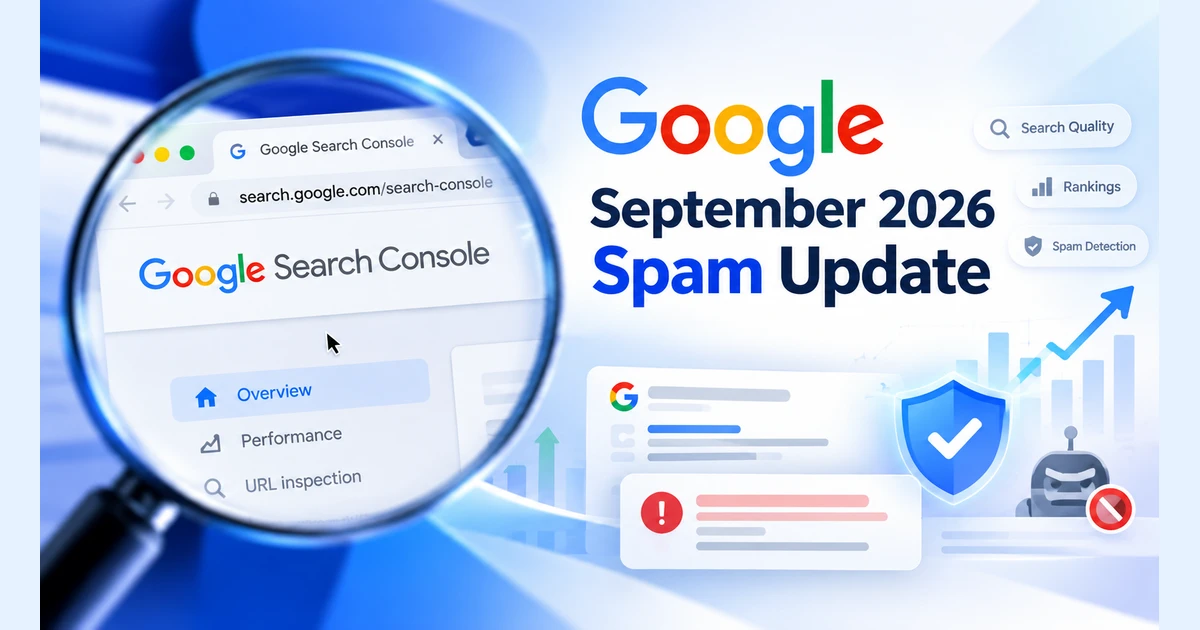
Google began its September 2026 spam update on September 24. It applies globally and across all languages, and Google says the rollout may take up to two weeks. The announcement does not name a specific target or explain the system changes.
What Google Confirmed
The Google Search Status Dashboard records the rollout start as September 24, 2026 at 09:15 PDT. It classifies the incident as affecting ranking and says the update applies globally, across all languages. Google’s stated completion window is up to two weeks.
Status checked October 2, 2026: the dashboard has not posted a completion notice. The rollout window is an estimate; it does not mean every site will see ranking changes or that changes will happen evenly throughout the period.
How This Rollout Compares With Earlier 2026 Spam Updates
The official ranking update history lists three earlier spam updates in 2026:
- March: 19 hours and 30 minutes, beginning March 24.
- June: 2 days and 1 hour, beginning June 24.
- August: 2 days and 16 hours, beginning August 18.
That makes September the fourth confirmed spam update of the year. Its stated window is longer than the completed March, June, and August rollouts. Google has not said that this means the update is broader in scope; the supported distinction is the longer possible rollout window.
What Google Has Not Said
The status notice does not name a particular spam tactic, content format, language, or class of website being targeted. It also does not promise a ranking effect for any site. Avoid treating unverified claims about the update’s target as confirmed Google guidance.
Google’s general spam update guidance explains that these updates are notable improvements to automated spam-detection systems. It advises sites that see changes to review Google’s spam policies.
What Site Owners Should Do Now
- Record a baseline. In Search Console, note clicks, impressions, and average position for important pages and queries before comparing later periods.
- Monitor until Google confirms completion. Avoid attributing a short-lived fluctuation to this update. Fix known spam-policy violations now rather than waiting for the rollout to finish.
- Review the affected pages. If a sustained decline appears after completion, check the pages and practices involved against Google’s published spam policies. Do not assume the update’s target without evidence.
- Separate search visibility from analytics attribution. Search Console clicks and GA4 sessions measure different things. If the reports diverge, use our GA4 UTM troubleshooting guide to check campaign tagging and session-source issues.
Google’s spam-update guidance says improvements can take months to be reflected as its systems reassess policy compliance. A correction does not guarantee an immediate ranking recovery.
We’ll update this news brief if Google posts a completion notice or publishes more detail about the rollout.
Choose a focused guide
Use these guides when you need to investigate a specific part of this topic.
- Google Delays DSA Migration to AI Max Until February 2027: What Advertisers Should Do
Google moved Dynamic Search Ads auto-migration to February 2027. See the January creation cutoff, what changes, and a tracking and testing checklist.
- ChatGPT Dropped Its UTM Tags for a Week: What It Did to Your GA4 Data
From October 8 to 15, 2026, many ChatGPT links lost utm_source=chatgpt.com, so AI visits showed up as Direct in GA4. How to spot it, annotate it and report it.
References
- September 2026 spam update - Google Search Status Dashboard (Google Search Status Dashboard)
- Google Search ranking updates history (Google Search Status Dashboard)
- Google Search spam updates and your site (Google Search Central)