

UTM Naming Conventions: Frameworks, Formats, and Governance Rules
Master UTM naming conventions. Discover field-tested campaign naming formulas, delimiter rules, case-sensitivity guidelines, and downloadable taxonomy SOPs.
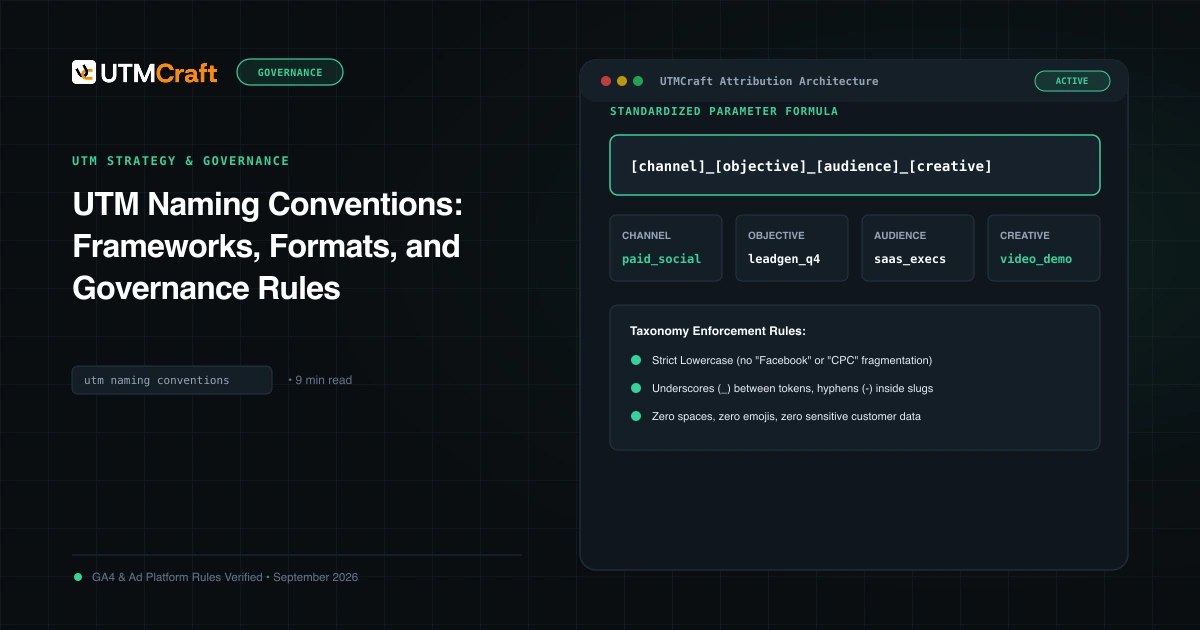
Table of Contents
Inconsistent UTM naming conventions are the #1 cause of corrupt marketing analytics. When your team uses Facebook, facebook, fb_ad, and cpc interchangeably, your GA4 reporting splits a single campaign across a dozen disjointed rows.
The 5 Golden Rules of UTM Naming
Before designing a naming formula, your organization must adopt these five structural rules as law:
Google Analytics 4 is strictly case-sensitive. utm_source=LinkedIn and utm_source=linkedin will appear as two distinct rows in your acquisition reports, splitting session counts and muddling attribution. Configure your link builder tool to lowercase every input automatically.
Spaces in URLs are converted to ugly, hard-to-read encoded sequences like %20 or + (e.g. utm_campaign=summer%20sale%202026). Always replace spaces with hyphens or underscores.
Rule 3: Match utm_medium to GA4 Default Channel Groupings. GA4 classifies traffic into channels (Paid Social, Paid Search, Email, Affiliates) based on strict regex matches against utm_medium and utm_source. If you use non-standard mediums like promoted-post instead of paid_social, GA4 assigns the traffic to "Unassigned".
Rule 4: Separate Metadata With a Consistent Delimiter. Standardize on _ as your token delimiter in campaign strings to allow programmatic parsing in SQL or BI dashboards.
Rule 5: Keep PII Out of Tracking Links. Never include email addresses, customer names, phone numbers, or user IDs in UTM strings. This violates Google Analytics Terms of Service and data protection regulations (GDPR/CCPA).
The Universal Campaign Naming Formula
A battle-tested campaign name formula answers four strategic questions when viewed in an analytics report:
[geo]_[product-line]_[objective]_[flight-time]

Real-World Production Example:
utm_campaign=eu_cloud-storage_leadgen-trial_2026q2| Token | Question Answered | Approved Examples |
|---|---|---|
geo |
Where is this traffic targeted? | us, emea, apac, latam, global |
product-line |
Which product or service is featured? | saas-pro, enterprise, mobile-app |
objective |
What is the conversion goal? | demo-request, free-trial, newsletter-sub |
flight-time |
When did this campaign launch? | 2026q1, 2026-03, evergreen |
Field-by-Field Parameter Standards
- utm_source: The specific platform sending traffic (e.g.
google,facebook,linkedin,newsletter-weekly,partner-acme). Always lowercase. - utm_medium: The high-level distribution mechanism. Must align with GA4:
cpc,paid_social,email,affiliate,referral,display,video. - utm_campaign: The structured campaign formula described above.
- utm_content: Used to differentiate creatives, ad formats, or CTA placements (e.g.
video-testimonial-60s,static-blue-banner,header-cta-button). - utm_term: Used for paid search keywords or audience targeting segments (e.g.
{keyword}in Google Ads orit-directors-500-plusin LinkedIn). - utm_id: The platform campaign ID (e.g. Google Ads Campaign ID, Meta Campaign ID) used for data cost import into GA4.
Real-World Examples by Channel
Paid Social (Meta Ads)
https://example.com/pricing?utm_source=facebook&utm_medium=paid_social&utm_campaign=us_b2b-suite_trial_2026q2&utm_content=ugc-video-founder&utm_id=12020495830201Paid Search (Google Ads with ValueTrack)
https://example.com/demo?utm_source=google&utm_medium=cpc&utm_campaign=na_core-search_demo_2026&utm_term={keyword}&utm_content={creative}&utm_id={campaignid}Team Rollout SOP & Quality Assurance
- Distribute the taxonomy reference guide to all internal stakeholders and media agencies.
- Audit every link using UTMCraft UTM Checker before sending budget live.
- Review GA4 Acquisition reports bi-weekly for any rogue sources or Unassigned channel spikes.
Sources & Authoritative References
- Campaign & Traffic Source Dimensions in GA4 (Google Analytics Help)
- URI Syntax Specification (RFC 3986) (IETF)
Related Measurement Guides
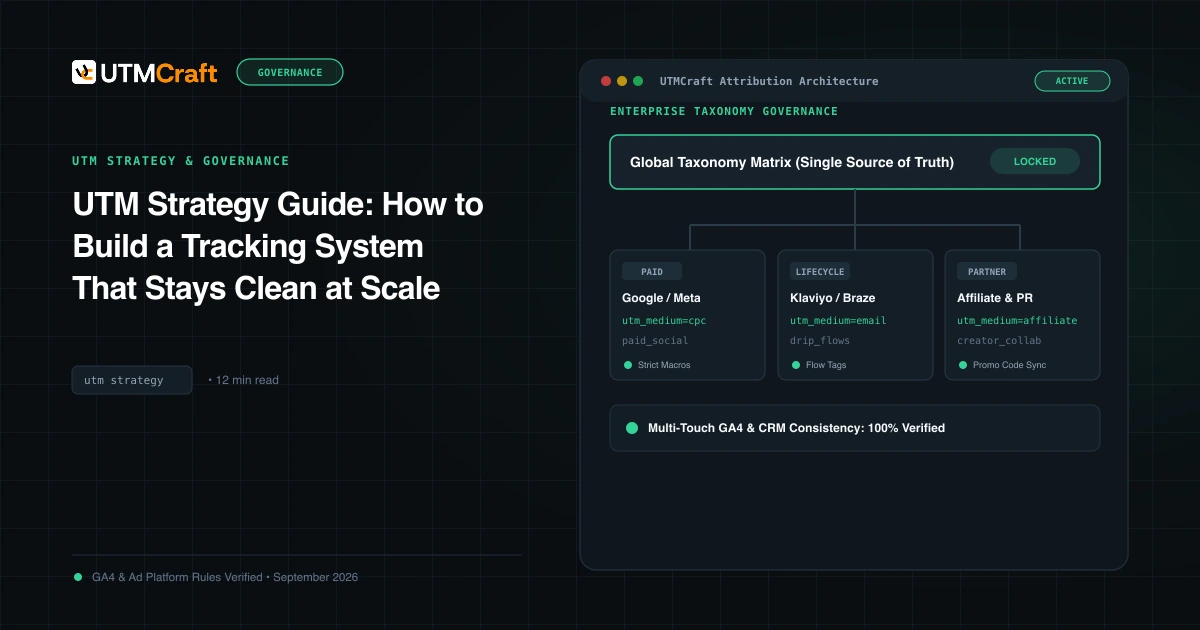
UTM Strategy Guide: How to Build a Tracking System That Stays Clean at Scale
Learn how to build an enterprise-grade UTM tracking strategy. Prevent fragmented GA4 reports, establish naming standards, and enforce governance at scale.
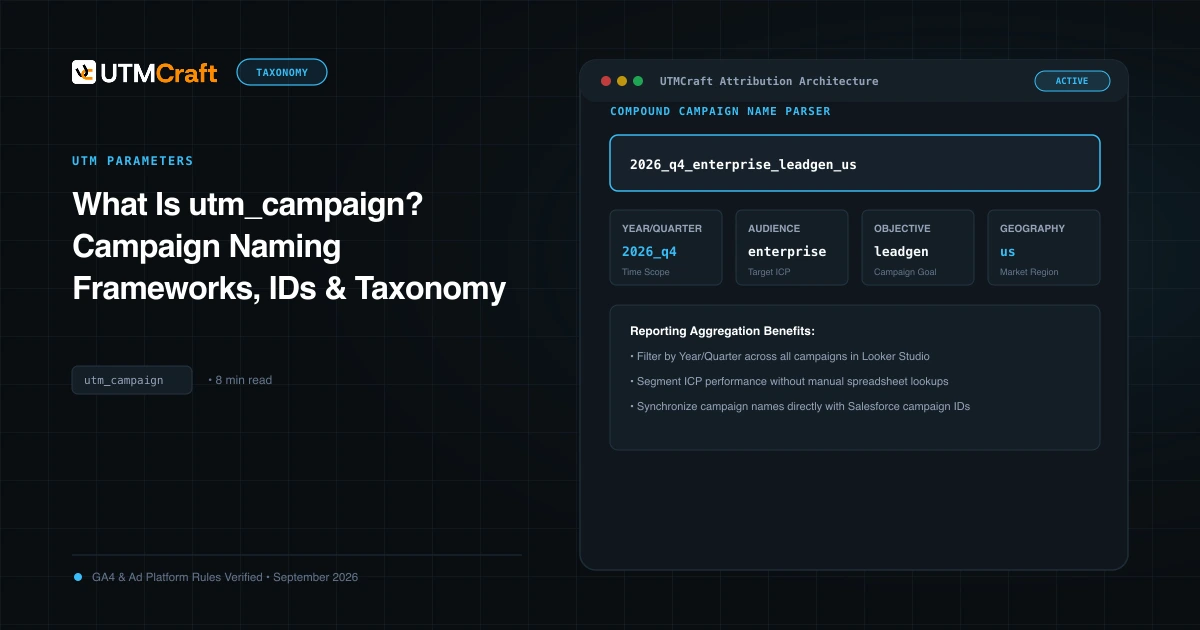
What Is utm_campaign? Campaign Naming Frameworks, IDs & Taxonomy
Learn how to structure utm_campaign for clear GA4 reporting. Discover formula frameworks, campaign IDs (utm_id), delimiter best practices, and real examples.
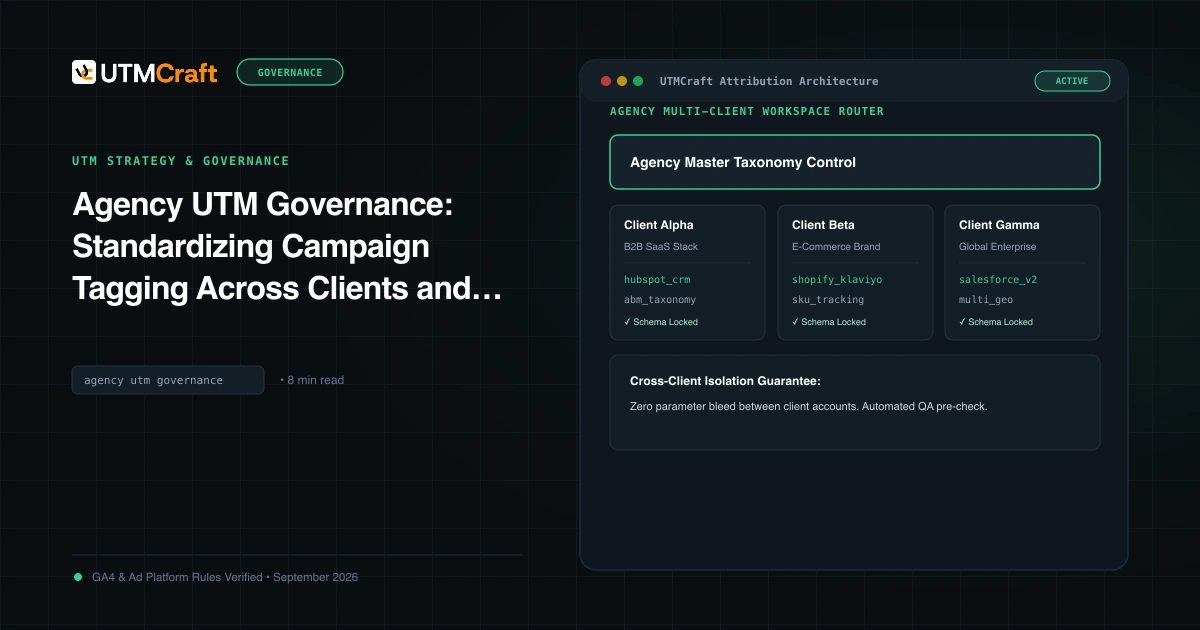
Agency UTM Governance: Standardizing Campaign Tagging Across Clients and Teams
How digital agencies manage UTM tracking governance across multiple client accounts, media teams, and ad platforms without breaking GA4 attribution.