

UTM Strategy Guide: How to Build a Tracking System That Stays Clean at Scale
Learn how to build an enterprise-grade UTM tracking strategy. Prevent fragmented GA4 reports, establish naming standards, and enforce governance at scale.
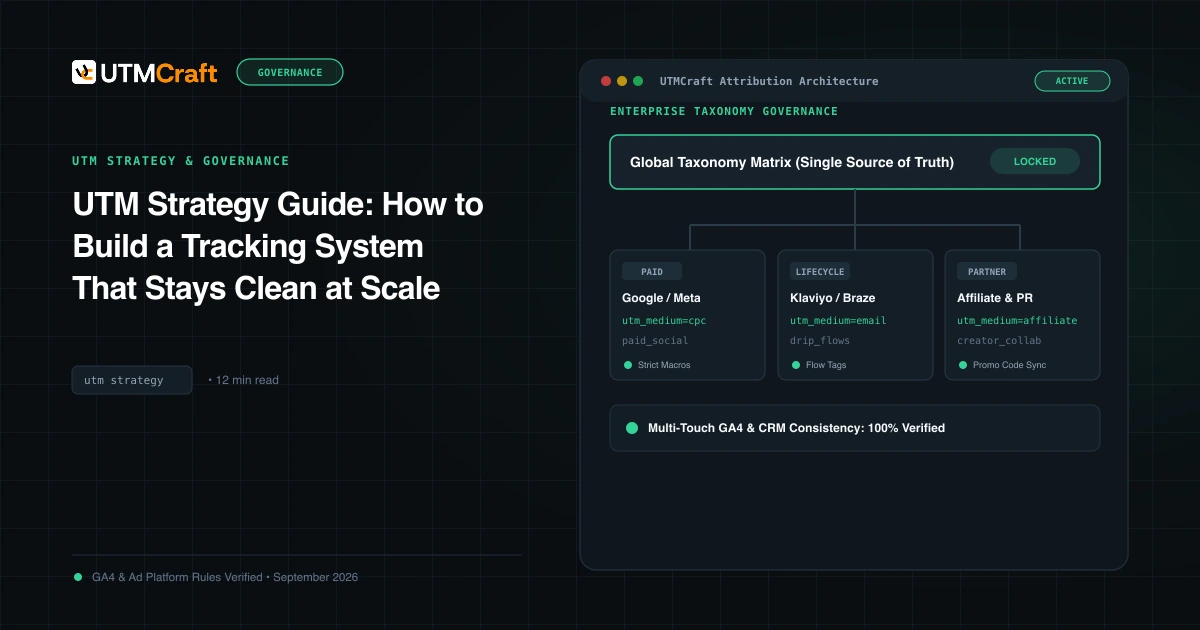
Table of Contents
- Why Most UTM Tracking Strategies Collapse at Scale
- The 3 Pillars of Scalable Tracking Architecture
- Enterprise Naming Hierarchy & Delimiter Standards
- Cross-Team Governance: Marketing, Media Agencies & RevOps
- Replacing Fragile Spreadsheets With Enforced Tooling
- How to Migrate Away From Broken Historical UTMs
- Frequently Asked Questions
A scalable UTM strategy is not a spreadsheet with 40 columns that nobody updates. It is a documented taxonomy, an enforced parameter delimiter structure, and a deterministic workflow that makes human error structurally impossible before links are published.
Your analytics platform (GA4) cannot fix bad input retrospectively. In GA4, Session source / medium dimensions are immutable once processed. An error in an active paid campaign corrupts multi-touch attribution, custom channel groupings, and revenue reporting permanently for that cohort.
Why Most UTM Tracking Strategies Collapse at Scale
Tracking systems rarely fail because marketers don't understand what UTM parameters stand for. They fail because of organizational entropy across three fault lines:
- Channel Team Isolation: The paid social team uses
utm_medium=paid-social, the influencer agency usesutm_medium=influencer, and the performance search agency usesutm_medium=cpc. GA4 dumps the first two into "Unassigned" because they fail GA4's default channel grouping regex. - Case-Sensitivity Fragmentation: Without client-side sanitization, team members type
Google,google,Facebook,FB, andig. GA4 treats each variation as a distinct source entity. - Free-Form Campaign Inputs: Marketing managers name campaigns after their internal project codes (
q4-launch-final-v2), stripping all programmatic context needed by BI and RevOps to analyze offer types or audience tiers.
The 3 Pillars of Scalable Tracking Architecture
A resilient tracking system rests on three non-negotiable architectural layers:
| Layer | Governance Mandate | Enforcement Mechanism |
|---|---|---|
| 1. Controlled Dictionaries | Lock down utm_source and utm_medium to pre-approved values strictly mapped to GA4 Default Channels. |
Pre-configured dropdowns in builder tools; automated link checker rejections. |
| 2. Structured Taxonomy | Standardize utm_campaign into machine-parsable, delimited sub-tokens (e.g. [region]_[product]_[objective]_[date]). |
Formulaic campaign generators; regex validation on pull requests and ad launches. |
| 3. Pre-Flight Verification | Zero links enter production without passing an HTTP 200, query-string preservation, and case-audit check. | Automated link inspectors (UTM Checker) integrated into QA sign-offs. |
Enterprise Naming Hierarchy & Delimiter Standards
When reporting across thousands of campaigns in BigQuery or GA4 Explorations, you need to extract dimensions from campaign strings. Mixing hyphens and underscores indiscriminately destroys regular expressions.
Use underscores (_) between distinct taxonomy fields, and hyphens (-) between compound words inside a single field:
utm_campaign=us_b2b-saas_demo-request_q4-2026
             │  │         │            └─ Timeframe: q4-2026
             │  │         └────────────── Objective: demo-request
             │  └──────────────────────── Product Line: b2b-saas
└─────────────────────────── Market/Geo: usThis allows your data team to run simple SQL split queries in BigQuery without unpredictable parsing errors:
-- BigQuery GA4 Event Export Extraction
SELECT
  SPLIT(traffic_source.name, '_')[SAFE_OFFSET(0)] AS geo,
  SPLIT(traffic_source.name, '_')[SAFE_OFFSET(1)] AS product_line,
  SPLIT(traffic_source.name, '_')[SAFE_OFFSET(2)] AS objective,
  SPLIT(traffic_source.name, '_')[SAFE_OFFSET(3)] AS flight_date,
  COUNT(DISTINCT user_pseudo_id) AS total_users
FROM `your-project.analytics_123456789.events_*`
WHERE event_name = 'session_start'
GROUP BY 1, 2, 3, 4;Cross-Team Governance: Marketing, Media Agencies & RevOps
To keep UTM tracking clean as teams scale past 20+ contributors, assign explicit taxonomy roles:
- Taxonomy Owner (Analytics / RevOps Lead): Maintains the single source of truth dictionary for allowed values. Reviews channel grouping additions quarterly.
- Channel Operators (Media Buyers, Email Specialists): Responsible for generating links exclusively through verified tooling rather than manual text edits.
- Agency Partners: Given locked templates containing client-mandated parameters. Agency contracts should specify that links with unapproved UTM values or uppercase characters are considered tracking defects.
Replacing Fragile Spreadsheets With Enforced Tooling
Shared spreadsheets inevitably decay. Someone pastes formatted text with uppercase characters, accidental spaces, or trailing slashes, breaking your campaign parameters. Replace spreadsheets with dedicated client-side generators:
- Auto-sanitize all inputs to lowercase automatically.
- Convert spaces to hyphens or underscores instantly.
- Validate destination URLs to verify they return HTTP 200 and do not strip query parameters across 301 redirects.
- Strip duplicate or accidental existing UTMs before appending new tracking keys.
Never put UTM parameters on internal banners, homepage sliders, or header navigation links pointing to other pages on your own website. When a user clicks an internal link with UTMs, GA4 immediately ends their current session, starts a new session, overwrites the original marketing referrer (e.g. Google Ads or Organic Search), and attributes all downstream conversions to your internal page!
How to Migrate Away From Broken Historical UTMs
If your GA4 property is already cluttered with inconsistent parameters, follow this 4-step phased migration:
- Conduct a 90-Day UTM Audit: Export all
Session source / mediumandSession campaignvalues from GA4. Group all variations into canonical targets (e.g., mapcpc,AdWords,google-adstogoogle / cpc). - Publish Your Tracking Standard Operating Procedure (SOP): Document the approved dictionary and formulas. Provide pre-built presets for Google Ads, Meta, and LinkedIn.
- Configure GA4 Custom Channel Groups: While standard GA4 Default Channel Grouping rules cannot be edited retroactively, create a Custom Channel Group in GA4 Admin that regex-maps your legacy historical values into the correct reporting buckets alongside your new clean values.
- Lock Link Generation to Approved Generators: Mandate that all future campaign links be generated using UTMCraft Bulk Matrix or single builders.
Frequently Asked Questions
Should we use hyphens or underscores in campaign names?
Both are valid URL characters. The industry-leading standard is using underscores to separate distinct taxonomy dimensions (e.g. region_product_funnel) and hyphens between compound words within a dimension (e.g. brand-awareness). Whichever standard you choose, document it and never allow team members to invert it.
How do UTMs affect Google Ads auto-tagging?
Google Ads auto-tagging appends the gclid parameter, which passes complete impression, auction, and keyword data to GA4. If you also append manual UTMs (for CRM or third-party attribution), GA4 prioritizes GCLID dimensions by default unless "Allow manual tagging (UTM values) to override auto-tagging" is explicitly checked in GA4 Property Settings.
Why should UTM parameters never be used on internal website links?
Appending UTMs to internal links (like banners or header navigation) causes GA4 to immediately terminate the visitor's current session and launch a brand new session with internal source data. This overwrites the original marketing origin (erasing Paid Search or Social ad attribution), artificially inflates session counts, and degrades conversion tracking.
Who should own and manage campaign UTM taxonomy across an organization?
Campaign taxonomy should be formally owned by a central Marketing Operations or Digital Analytics lead, with explicit write permissions over the master campaign dictionary. Cross-functional media teams (Paid Media, Lifecycle, SEO, Influencer) should generate links strictly through approved presets or generators like UTMCraft to prevent naming divergence.
Sources & Authoritative References
- Google Analytics 4 Default Channel Grouping (Google Analytics Help)
- Dimensions & Metrics in GA4 (Google Analytics Help)
Related Measurement Guides
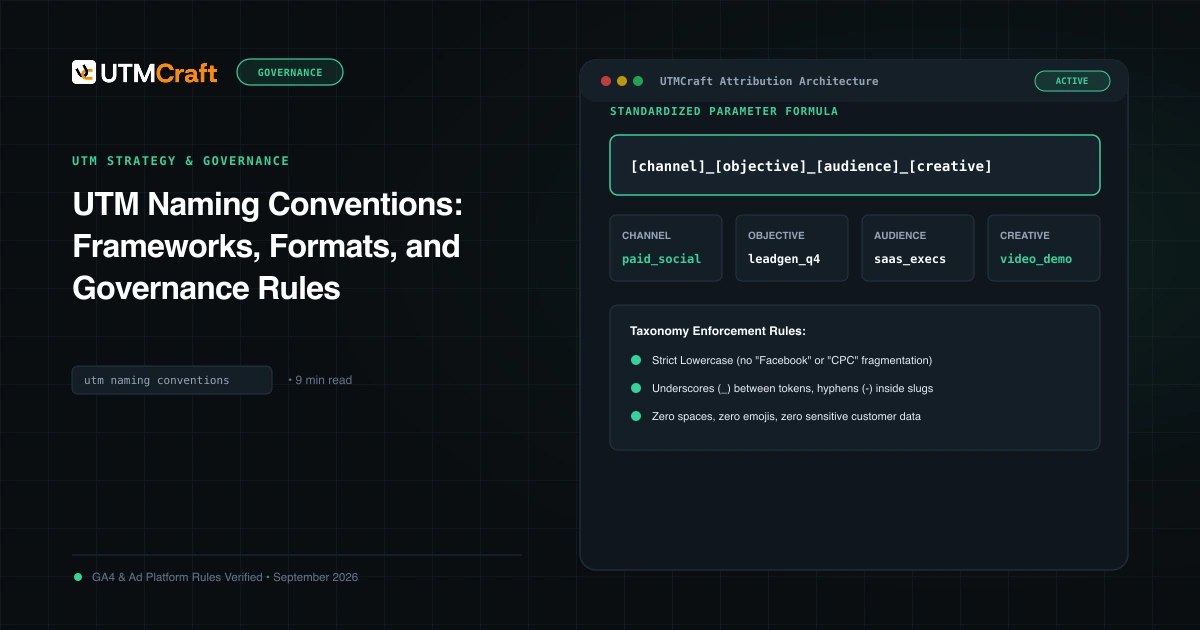
UTM Naming Conventions: Frameworks, Formats, and Governance Rules
Master UTM naming conventions. Discover field-tested campaign naming formulas, delimiter rules, case-sensitivity guidelines, and downloadable taxonomy SOPs.
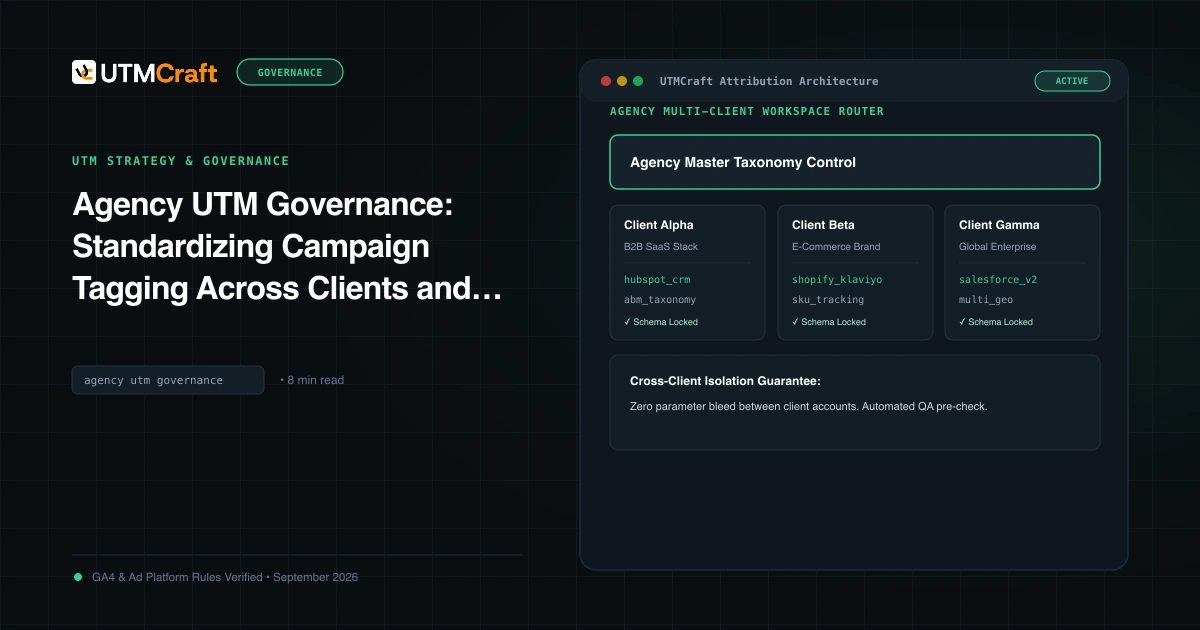
Agency UTM Governance: Standardizing Campaign Tagging Across Clients and Teams
How digital agencies manage UTM tracking governance across multiple client accounts, media teams, and ad platforms without breaking GA4 attribution.
Pre-Launch UTM QA Checklist: 16 Steps to Prevent Broken Campaign Attribution
Prevent broken tracking before you launch. A comprehensive 16-step quality assurance checklist for validating UTM links, redirects, casing, and GA4 DebugView.